
Senior care / Interior design
European Healthcare Design 2018
Floor patterns as a potential risk factor for the elderly and cognitively impaired?
By Dr Birgit Dietz and Dr Janine Dieh Schmid | 08 Jun 2018 | 0
The aim of this study is to investigate how flooring is perceived, in particular, by people with mild cognitive impairment and in terms of the impact of dark-coloured stripes or shapes.
Abstract
Floor patterns as a potential risk factor for the elderly and cognitively impaired?
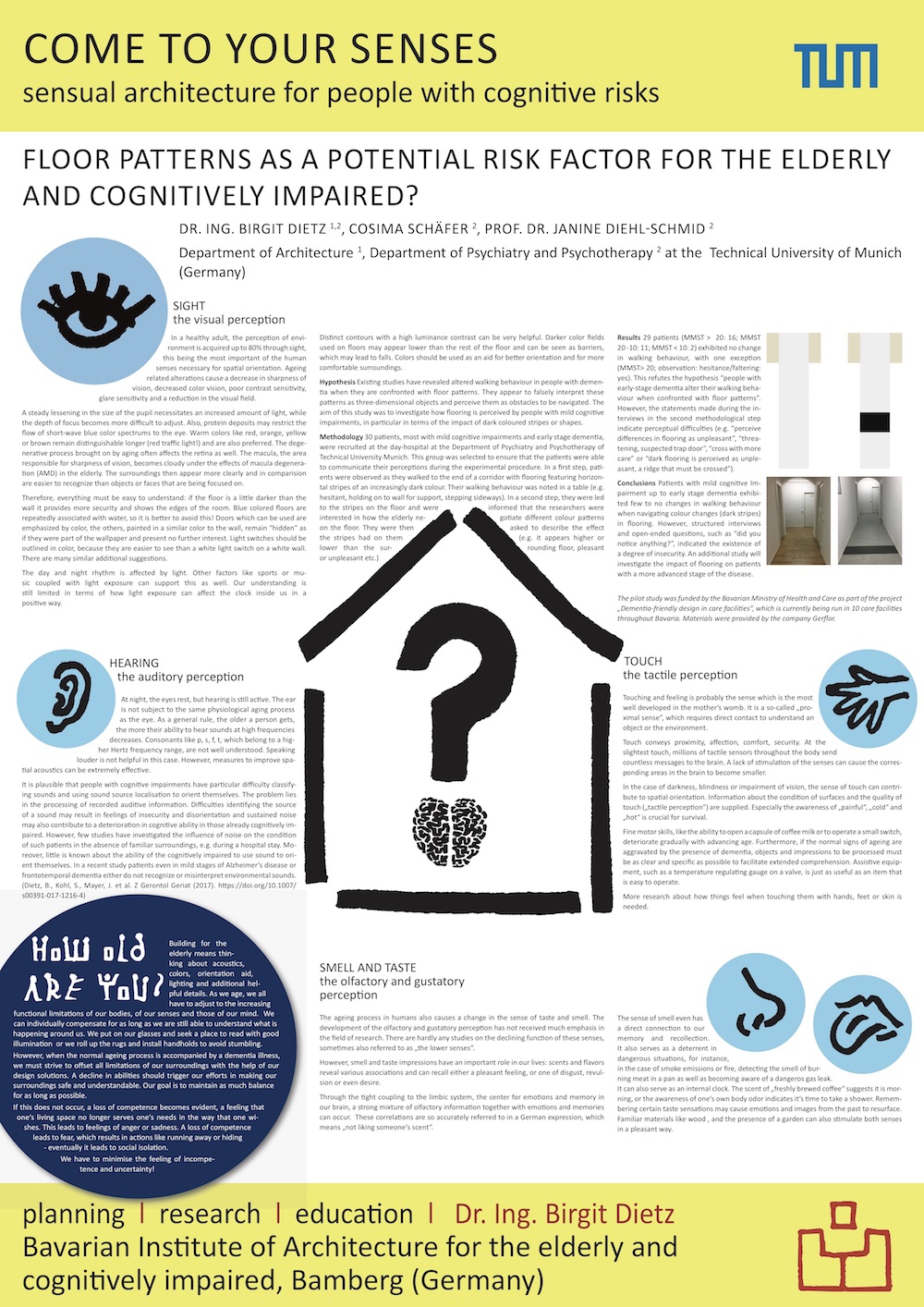
Existing studies have revealed an altered gait in people with dementia when they’re confronted with floor patterns. They appear to falsely interpret these patterns as three-dimensional objects and perceive them as obstacles to be navigated. The aim of this study is to investigate how flooring is perceived, in particular, by people with mild cognitive impairment and in terms of the impact of dark-coloured stripes or shapes.
Method: Patients with mild cognitive impairments and early-stage dementia will be recruited at the day unit 50plus at the Clinic and Polyclinic for Psychiatry and Psychotherapy at the Technical University of Munich. They will be guided along a corridor 8m in length, initially with light, unpatterned flooring, and then with a horizontal stripe positioned across the middle of the corridor in an increasingly dark colour. Patients’ gait will be observed and their reactions to the stripe will be elicited. The same process will subsequently be repeated on dark flooring with increasingly light stripes added.
Results: This study is currently in progress and initial results obtained in the next few weeks will be reported at the conference. Potential changes in gait, such as hesitation, stumbling or a decrease in the length of stride will be recorded. Patients’ perception of the stripes will also be noted – for example, in terms of whether they’re regarded as an obstacle, whether they’re perceived to be at a higher or lower level to the rest of the floor, and whether they’re seen as pleasant or unpleasant.
Conclusions: Should significant alterations be observed in the gait or perception of patients, this could have far-reaching consequences for architectural design in healthcare facilities. Reducing floor patterning, for example, could facilitate patients’ progress through hospital corridors, and positioning dark-coloured stripes in front of exits to communal areas in residential accommodation may deter residents from leaving those areas.
Keywords: dementia, hospitals, healing architecture
Organisations involved