
Healthcare / Quality improvement
European Healthcare Design 2019
Designing accessible and affordable place-based healthcare in the US
By ERIN SHARP NEWTON and Ben P Lee | 12 Jun 2019 | 0
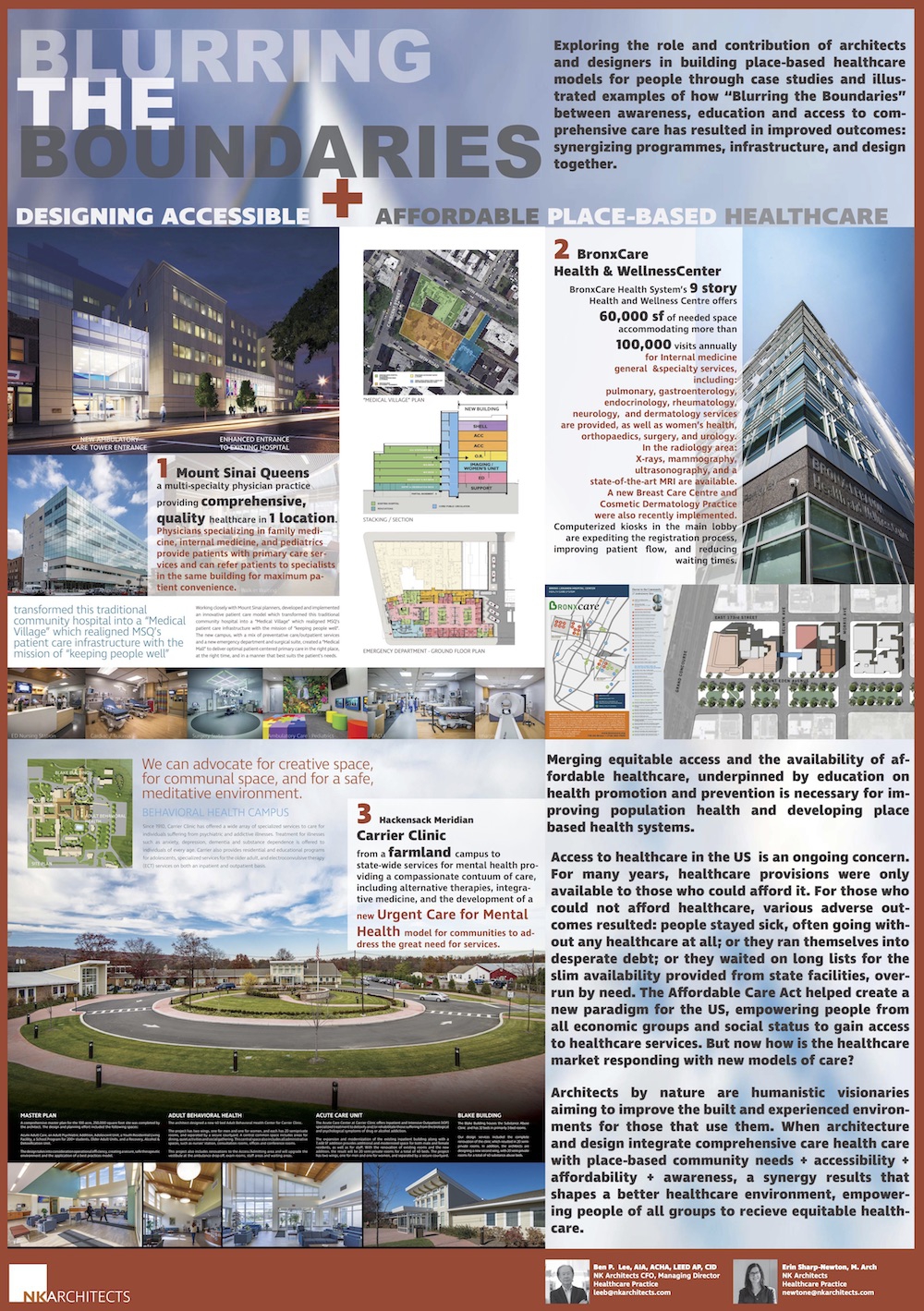
This poster will explore the role and contribution that architects and designers are making in the US towards building place-based healthcare models for the people in collaboration with healthcare professionals and clients.
Abstract
Merging equitable access and the availability of affordable healthcare, underpinned by education on health promotion and prevention, is necessary for improving population health and developing place-based health systems.
In the US, access to healthcare is an ongoing concern. For many years, healthcare provisions were only available to those who could afford it. For those who could not afford healthcare, various adverse outcomes resulted: people stayed sick, often going without any healthcare at all; or they ran themselves into desperate debt; or they waited on long lists for the slim availability provided from state facilities, overrun by need. The Affordable Care Act helped create a new paradigm for the US, empowering people from all economic groups and social status to gain access to healthcare services. But how is the healthcare market responding with new models of care?
Objectives and methodology: This poster will explore the role and contribution that architects and designers are making in the US towards building place-based healthcare models for the people in collaboration with healthcare professionals and clients. We will demonstrate through case studies and illustrated examples of how “blurring the boundaries” between awareness, education and access to comprehensive care has resulted in improved outcomes: synergising programmes, infrastructure and design together.
Results: Outcomes relating to the following three case examples will be described.
1. BronxCare Health and Wellness Center:
BronxCare Health System’s nine-storey Health and Wellness Center offers 60,000 square feet of space for general and specialty services, accommodating more than 100,000 visits annually. Internal medicine services – including pulmonary, gastroenterology, endocrinology, rheumatology, neurology, and dermatology – are provided, as well as women’s health, orthopaedics, surgery and urology. In the radiology area, x-rays, mammography, ultrasonography, and a state-of-the-art MRI are available. A new breast care centre and cosmetic dermatology practice were also recently implemented. Computerised kiosks in the main lobby are expediting the registration process, improving patient flow and reducing waiting times.
2. Mount Sinai Queens:
Mount Sinai Queens is a new multi-specialty physician practice providing comprehensive, quality healthcare in one location. Physicians specialising in family medicine, internal medicine, and paediatrics provide patients with primary care services and can refer patients to specialists in the same building for patient convenience.
3. Hackensack Meridian Carrier Clinic:
From a farmland campus to state-wide services for mental health providing a compassionate continuum of care, including alternative therapies, integrative medicine, and the development of a new Urgent Care for Mental Health model for communities to address the great need for services.
Conclusions and implications: Architects by nature are humanistic visionaries, aiming to improve the built and experienced environments for the human beings that use them. When architecture and design integrate comprehensive healthcare with place-based community needs, accessibility, affordability and awareness, a synergy results that shapes a better healthcare environment, empowering people of all groups to equitable healthcare.
Organisations involved