Healthcare / Facilities design
European Healthcare Design 2019
How are existing outpatient waiting areas in China used, occupied and functioning? A pilot study
By Sophie Crocker and Upali Nanda | 12 Jun 2019 | 0
Currently, there is a dearth of information regarding healthcare facility design and use in China. This poster details a pilot study that is one step on the way to beginning to fill that gap.
Abstract
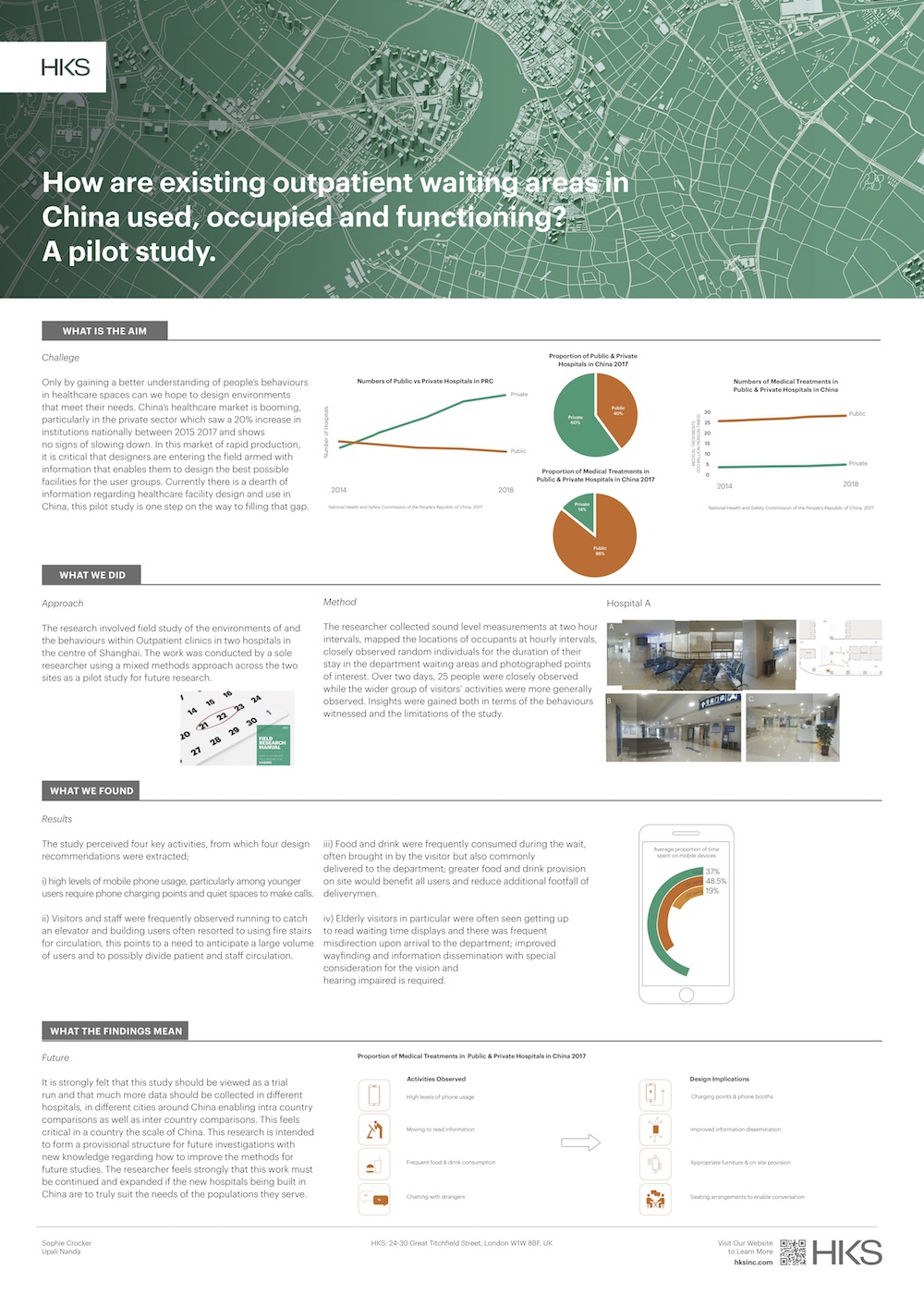
Only by gaining a better understanding of people’s behaviours in healthcare spaces can we hope to design environments that meet their needs. China’s healthcare market is booming, particularly in the private sector, which saw a 20-per-cent increase in institutions nationally between 2015–2017 and shows no signs of slowing down. In this market of rapid production, it’s critical that designers are entering the field armed with information that enables them to design the best possible facilities for the user groups. Currently, there is a dearth of information regarding healthcare facility design and use in China. This pilot study is one step on the way to beginning to fill that gap.
The research involved field study of the behaviours in and the environments of outpatient clinics within two hospitals in the centre of Shanghai: Ruijin Hospital and Huashan Hospital, affiliated with Jiaotong and Fudan Universities, respectively. The work was conducted by a sole researcher using a mixed methods approach across the two sites as a pilot study for future research. The researcher collected sound-level measurements at two-hour intervals, mapped the locations of occupants at hourly intervals, closely observed random individuals for the duration of their stay in the department waiting areas, and photographed points of interest. Over two days, 25 people were closely observed while the wider group of visitors’ activities were more generally observed. Insights were gained about the behaviours witnessed and the limitations of the study.
The study perceived four key activities, from which four design recommendations were extracted:
- high levels of mobile phone usage, particularly among younger users require phone-charging points and quiet spaces to make calls;
- visitors and staff were frequently observed running to catch an elevator and building users often resorted to using fire stairs for circulation – pointing to a need to anticipate a large volume of users and, possibly, to divide patient and staff circulation;
- food and drink were frequently consumed during the wait, often brought in by the visitor but also commonly delivered to the department, so greater food and drink provision on site would benefit all users and reduce additional footfall of deliverymen; and
- elderly visitors, in particular, were often seen getting up to read waiting-time displays and there was frequent misdirection on arrival to the department – so improved wayfinding and information dissemination, with special consideration for the vision and hearing-impaired, are required.
It’s felt strongly that this study should be viewed as a trial run and that much more data should be collected in different hospitals and in different cities around China, enabling intra-country comparisons as well as inter-country comparisons. This feels critical in a country the scale of China. This research is intended to form a provisional structure for future investigations with new knowledge about how to improve methods for future studies. The researcher feels strongly that this work must be continued and expanded if the new hospitals being built in China are to truly suit the needs of their populations.
Organisations involved