Women & children's / Service redesign
European Healthcare Design 2019
Creating a comfortable environment for children and young people with visual and hearing impairment
By Susan Meade | 12 Jun 2019 | 0
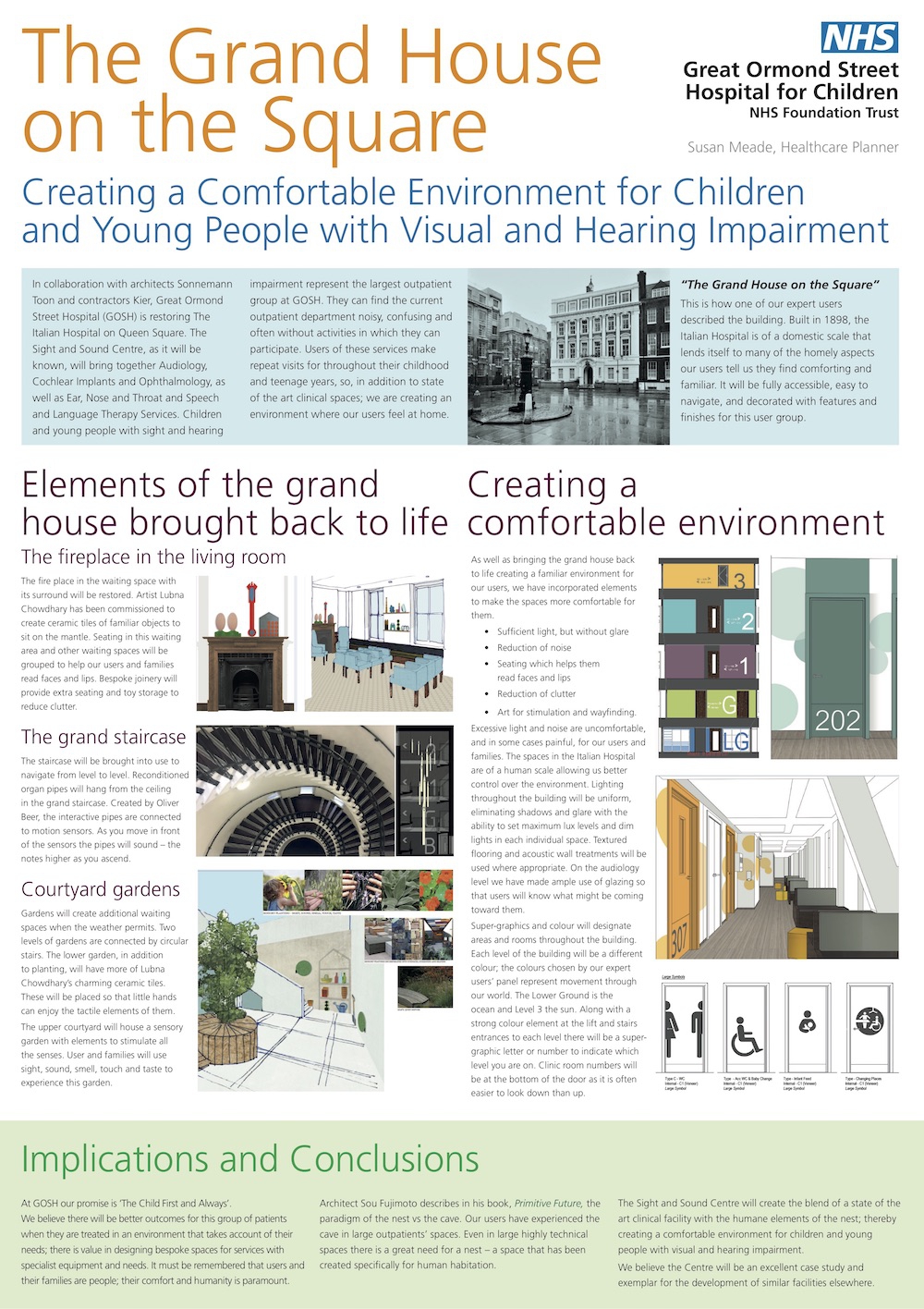
This poster focuses on the ‘Italian Hospital’, which Great Ormond Street Hospital is currently restoring back into a building for clinical use.
Abstract
Patients with sight and hearing impairment represent the largest outpatient group at Great Ormond Street Hospital (GOSH), and make more than 25,000 outpatient visits to GOSH each year. They can find waiting spaces noisy, confusing and often without activities in which they can participate. Those with sight and/or hearing impairment have similar requirements for comfortable spaces, including:
- sufficient light but without glare;
- reduction of noise;
- seating that helps them read faces and lips;
- reduction of clutter; and
- art for stimulation and wayfinding.
Description: In collaboration with industry consultants, GOSH is currently restoring the ‘Italian Hospital’, near the hospital’s main site, back into a building for clinical use. A feasibility study suggested it should be an outpatient facility and that the current ophthalmology and audiology services at GOSH would be the right size for the space. The Sight and Sound Centre, as it will be known, will bring together audiology, cochlear implant and ophthalmology as well as ear, nose and throat, and speech and language therapy services. Users of these services tend to make repeat visits for long-term follow-up throughout their childhood and teenage years.
Built in 1898, the ‘Italian Hospital’ is of a domestic scale that lends itself to many of the homely aspects our users tell us they find comforting and familiar. It will be fully accessible and easy to navigate. This will be the long-term location for these services. The building will be designed and decorated with special features and finishes for the patient group. In addition to state of the art clinical facilities, there will be:
- a dispensing optician;
- a sensory garden that families will be able to touch and smell, using their other senses to understand the world around them; and
- commissioned artwork incorporating sensory elements.
Outcomes: We believe there will be better outcomes for this group of patients when they are treated in an environment that takes account of their specific needs. There is value in considering scale to retain a humane element to care.
Implications: These include:
-
there is value in designing bespoke spaces for services with specialist equipment and needs;
-
it must be remembered that patients are people and their comfort and humanity is paramount;
-
humanising environments can improve health outcomes and experiences for the patient and their family;
-
once in use, a post-project evaluation will be conducted to identify strengths and weaknesses, including the effectiveness of the design features such as acoustics, colours and art; and
-
the centre will be used as a case study and we hope it will be an exemplar for development of similar facilities elsewhere.
Organisations involved