
Senior care / New models of care
European Healthcare Design 2019
Healthcare at home: designing for flexibility
By Mohammed Ul-Haq and Neil Orpwood | 12 Jun 2019 | 0
The aftershock of the housing crisis is felt across multiple sectors of public policy, not least in housing for the elderly and healthcare in general. This poster considers the implications and possible solutions.
Abstract
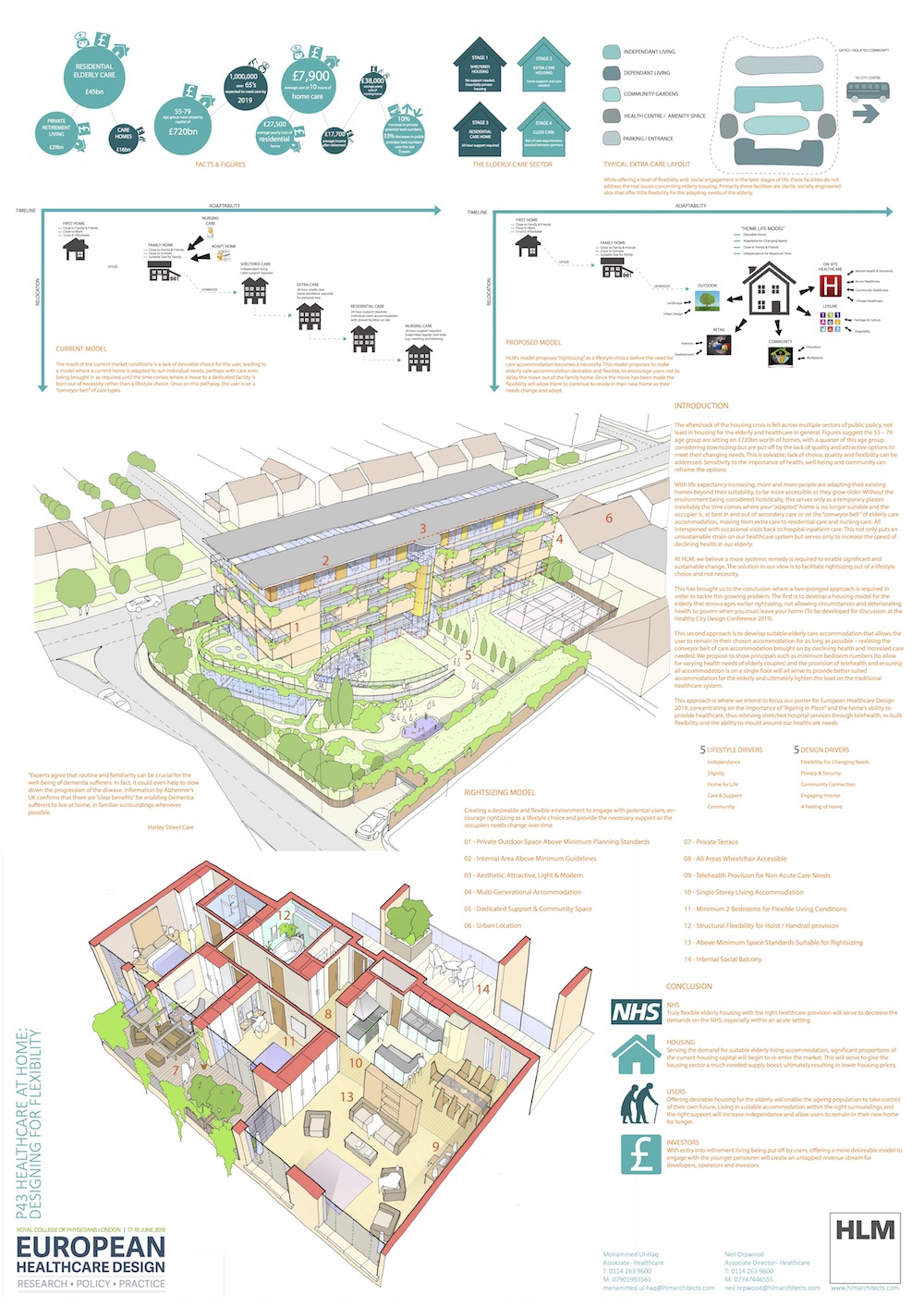
Figures suggest the 55–79 age group are sitting on £720 billion worth of homes, with a quarter of this age group considering downsizing but are put off by the lack of quality and attractive options to meet their changing needs. This is soluble: lack of choice, quality and flexibility can be addressed. Sensitivity to the importance of health, wellbeing and community can reframe the options.
With life expectancy increasing, a growing number of people are adapting their existing homes beyond their suitability to be more accessible as they age. Without the environment being considered holistically, this serves only as a temporary plaster. Inevitably, the time comes when your “adapted” home is no longer suitable and the occupier is, at best, in and out of secondary care or on the “conveyor belt” of elderly care accommodation – moving from extra care to residential care and nursing care, interspersed with occasional visits back to hospital inpatient care. This not only puts an unsustainable strain on our healthcare system but serves only to increase the speed of declining health in our elderly.
A more systemic remedy is required to enable significant and sustainable change. The solution is to facilitate rightsizing out of a lifestyle choice and not necessity. This has brought us to the conclusion that a two-pronged approach is required to tackle this growing problem.
The first is to develop a housing model for the elderly that encourages earlier rightsizing, not allowing circumstances and deteriorating health to govern when you must leave your home.
The second approach is to develop suitable elderly care accommodation that allows the user to remain in their chosen accommodation for as long as possible – resisting the conveyor belt of care accommodation brought on by declining health and increased care needed. We propose to show how principles such as minimum bedroom numbers (to allow for varying health needs of elderly couples), the provision of telehealth, and ensuring all accommodation is on a single floor will all serve to provide more suitable accommodation for the elderly and lighten the load on the traditional healthcare system.
Organisations involved
