Senior care / Innovation
Innovation Park demonstrates dementia-friendly design for independent living
By Andrew Sansom | 12 Jul 2018 | 0
Aimed at helping educate housebuilders, carers and relatives on how to better support those living with dementia, a new ‘dementia-friendly’ home has been developed by building science research centre BRE in partnership with Loughborough University.
Located on the BRE Innovation Park in Watford, the demonstration home is designed to explore how dementia sufferers can be supported to remain at home for longer than in a normal home, improving their quality of life, and reducing the cost of care to the state and relatives. It features a vast collection of intuitive ideas, all based on proven academic research – from simple open-plan living spaces to more hi-tech innovations such as ‘talking cushions’, which promote activity after long periods of rest, sensory ‘smart chairs’, self-regulating climate control, and safety sensors in high-risk areas, such as the kitchen.
All the features in the home were designed around a range of personas created especially for the project, which reflect four progressive stages of dementia – from early on-set to end-of-life. 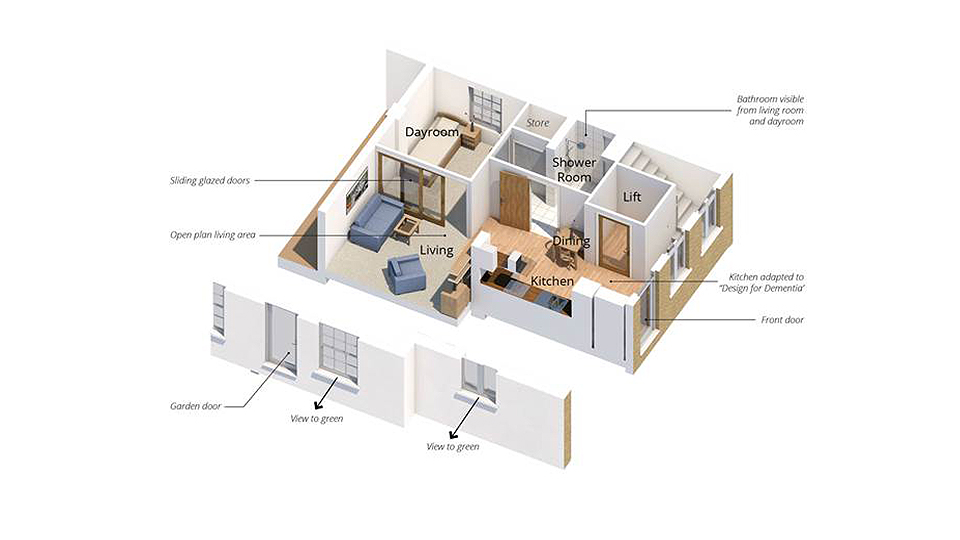
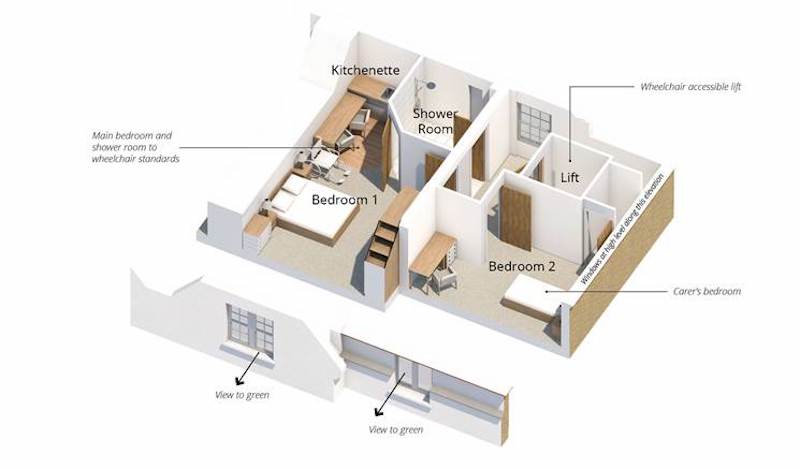
The 100sqm Victorian converted terrace house has been adapted to cater for different types and stages of dementia, with the upper floor of the home adapted for the more advanced stages of dementia.
Aimed at allowing sufferers to live independently by addressing their day-to-day needs, the building design has been developed around the needs of two specific personas (or avatars), Chris and Sally. The design narrative describes how the features of the building have been adapted to support them as they age well at home. The prototype will be supported by short films detailing how dementia affects Chris and Sally on a good, average and bad day, with different actors recreating the different stages of dementia. The films have been created by the Loughborough University.
Features of the demonstration house include:
- clear lines of sight and colour-coded paths through the home that help guide people towards each specific room;
- increased natural lighting to help people stay alert during the day and sleep better at night;
- automatically controlled natural ventilation to provide good indoor air quality;
- noise-reduction features to reduce stress;
- simple switches and heating controls, and safety sensors in high-risk areas, such as the kitchen;
- a ‘talking cushion’ with built-in sensors to remind people to get up, walk around and get a drink because walking is beneficial for health, and dehydration can cause cognitive problems;
- space to install a lift so the lounge does not become a bedroom when the stairs become difficult;
- a homely, simple and familiar interior design to help promote rest and relaxation.
According to the Alzheimer’s Society, dementia care affects about 850,000 people in the UK – a figure that’s expected to rise to more than 1 million by 2025. Two-thirds of the cost of dementia is paid by those who suffer from the condition and their families. This is in sharp contrast to other conditions, such as heart disease and cancer, where the NHS provides care that is free at the point of use.
 The £300,000 project has been designed by HLP Architects, and is based on the ‘design for dementia principals’ previously developed by Dr Rob McDonald, from Liverpool John Moores University, and Bill Halsall, from Halsall Lloyd Partnership. In future, the home will also be used to assist Loughborough University’s ongoing research into how the features are used, with a view to further improving ways to support homeowners with dementia. Other research partners involved with the project include AkzoNobel, John Lewis, Polypipe and Rockwool.
Director of BRE Innovation Parks Dr David Kelly said: “Many of the ideas put forward in the prototype home are just good sense for us all to incorporate into our properties to adapt to the process of ageing. Currently, the average cost of care can be between £30,000 and £40,000 per annum. Creating environments that allow people to live independently at home for longer could save a significant amount. That money could instead be channelled into research that alleviates the condition and reduces the emotional stress to the individual.”
The project draws expertise from several specialisms at Loughborough, including the schools of architecture, building and civil engineering, design, and sport – and it’s based on a wealth of dementia research carried out at the university.
“Most people experiencing dementia wish to remain at home, so the design and construction of new dwellings or home conversions are paramount,” said Eve Hogervorst, a psychology professor at Loughborough, and the university’s principal investigator on the project. “With this project we want to show how design solutions can be to be easily integrated within most current homes and communities to improve people’s lives.”
Organisations involved