
Cities / Active travel
Healthy City Design 2022
The Living Street
By Noor Itrajky and John Richards | 21 Dec 2022 | 0
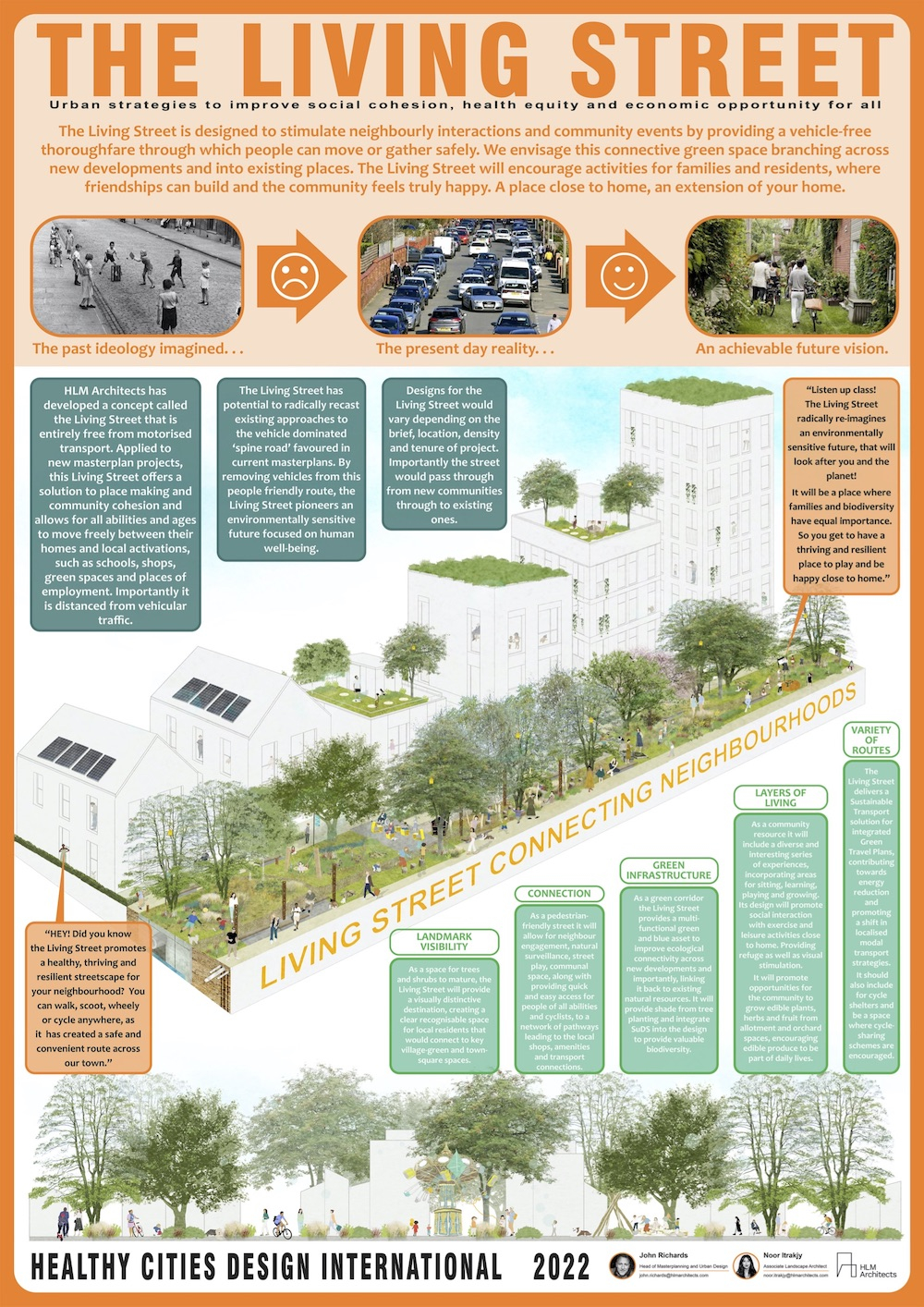
Healthy place shaping involves maximising opportunities for active travel and creating a safe environment. Connectivity, in terms of active travel such as walking and cycling, requires the development and promotion of safe, clear, convenient, and permeable routes and networks. HLM Architects has developed a concept in response to creating successful neighbourhoods called the ‘the Living Street’.
Abstract
Designed to be applied on masterplanning projects, the ‘street’ will form a pedestrian and ‘leisure’ cycle-friendly route, which feeds into key activation areas, e.g. schools, local centres, green spaces and employment zones.
The ‘Living Street’ has the potential to radically rethink and pioneer an environmentally sensitive future and address the climate emergency. It promotes an ecosystem-led approach where people and biodiversity have equal importance, creating a balanced, thriving and resilient streetscape.
The concept for the Living Street has been devised on three key sizes of living street: 20m, 12m, and 8m. The sizes are adaptable depending on the brief.
Key intervention strategies:
Pedestrian-friendly streets:
- promoting walking /cycling;
- creating safe routes in an integrated transport network; and
- keeping pedestrian footpaths either side of the residential properties and a 2m-wide leisure cycle route (in accordance with the Department of Transport’s policy paper, ‘Gear Change’).
Layers of learning:
- the living street as a community resource will provide areas for learning and play – it’s important that a diverse and interesting series of learning and play
opportunities spaces are designed along the journey; and - encouraging social recreation in green spaces – exercise and leisure.
Green and blue infrastructure:
- green corridors – providing a multi-functional asset that improves ecological connectivity
- reduction in the surface temperatures and provision of trees for shade utilising native species; and
- sustainable urban drainage systems integrated into the landscape, with all water captured and attenuated on site.
Social space
- active ‘village green’ and ‘town square’ social spaces at the heart of masterplan designs; and
- the ability for the community to grow edible herbs and pick fruit from the community orchard, helping form an important circular micro-economy.
Sustainable transport:
- sustainable energy and transport strategies embedded within the design;
- cycle shelters, networks and cycle-sharing schemes; and
- electric car charging points within the streetscape.
Organisations involved
