
Charities and Voluntary Bodies / Healthy Cities
Focus on children to help shape sustainable cities, Unicef guide says
By Andrew Sansom | 01 Nov 2018 | 1
Unicef has published a new handbook on child-responsive urban planning that presents concepts, evidence and technical strategies to bring children to the foreground of urban planning.
By focusing on children, the publication provides guidance on the role that urban planning should play in achieving the UN’s Sustainable Development Goals (SDGs), by creating thriving and equitable cities where children live in healthy, safe, inclusive, green and prosperous communities. Called ‘Shaping urbanisation for children’, the handbook aims to inspire everyone involved in planning, designing, transforming, building and managing the built environment.
The handbook points out that despite efforts to upgrade slums, the total number of slum dwellers has grown to 880 million – and an estimated 300 million of the global population of slum dwellers are children. Without investment in planning, urban expansion becomes fragmented and haphazard, resulting in a lack of public space and no compactness in urban form. For children, says the guide, it means unhealthy and unsafe environments, few options for walking and playing, and limited connectivity to social networks, services and the local economy. 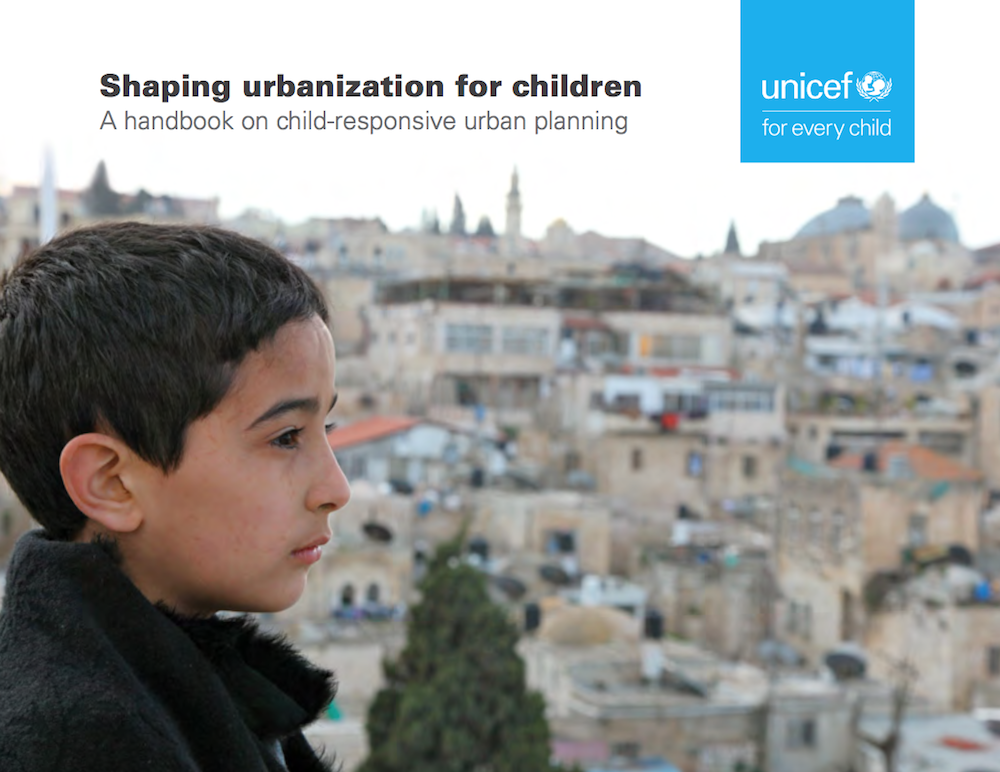
Another major issue is that cities’ energy consumption and carbon dioxide emissions are putting stress on both the natural environment and manmade infrastructure. Improved use of urban resource systems necessitates innovation in energy efficiency, and in forging sustainable lifestyles, says the guide.
“As children’s behaviour is moulded by their ongoing interaction with the urban environment, children’s participation in shaping sustainable cities will be a determinant for the future of our cities and the planet,” says the publication.
In urban settings, there is a strong correlation between the vulnerability of the most disadvantaged children and the built environment, adds the handbook. An unsustainable built environment restricts children from accessing urban services in a physical way, owing to unequal distribution, ineffective planning, and lack of quality in design and construction.
This results in urban-specific environmental health problems that health support systems cannot address alone, shifting the focus from communicable to non-communicable diseases. The built environment also influences the extent to which children participate, in both public space and other infrastructure that allows physical, social and digital connectivity.
According to Unicef, child-responsive urban settings resonate qualities that many scholars have described as conceptual standards for sustainable neighbourhoods and cities: urban scales; proximity; walkability; mixed use; public space; independent mobility; and connectivity.
Children’s Rights and Urban Planning Principles
The handbook lists 10 Children’s Rights and Urban Planning Principles that cities can follow to safeguard children’s development. All cities, says the guide, should commit to:
- Investments – respect children’s rights and invest in child-responsive urban planning that ensures a safe and clean environment for children and involves children’s participation in area-based interventions, stakeholder engagement and evidence-based decision-making.
- Housing and land tenure – provide affordable and adequate housing, and secure land tenure for children and the community, where they feel safe and secure.
- Public amenities – provide infrastructure for health, educational and social services for children and the community.
- Public spaces – provide safe, inclusive public and green spaces for children and the community.
- Transportation systems – develop active transportation and public transit systems, and ensure independent mobility for children and the community.
- Integrated water and sanitation management systems – develop safely managed water and sanitation services and ensure an integrated urban water management system for children and the community.
- Food systems – develop a food system with farms, markets and vendors, so children and the community have permanent access to healthy, affordable and sustainably produced food and nutrition.
- Waste cycle systems – develop a zero waste system and ensure sustainable resource management.
- Energy networks – integrate clean energy networks and ensure reliable access to power.
- Data and ICT networks – integrate data and ICT networks, and ensure digital connectivity for children, and the community, to universally accessible, affordable, safe and reliable information and communication.
Unicef believes that by prioritising children, urban planning will contribute in three ways: area-based urban programmes enable better service delivery for children, as well as a clean and safe built environment; process-oriented urban development involves children’s participation in coalition building and the co-production of child-responsive urban settings; and evidence-driven and child-centred decision-making considers the spatial component of urban inequity to which the most disadvantaged children are exposed.
Organisations involved